
2.5 D Nesting
Minimum Waste Construction
2020-2022 | transLAB, Advanced Studio: Embedded Intelligence & CCA Digital Craft Lab, San Francisco.
Collaborators: Borhani
Links: Nesting Fabrication
Research Description: 2.5D Nesting for Open and Closed Geometries
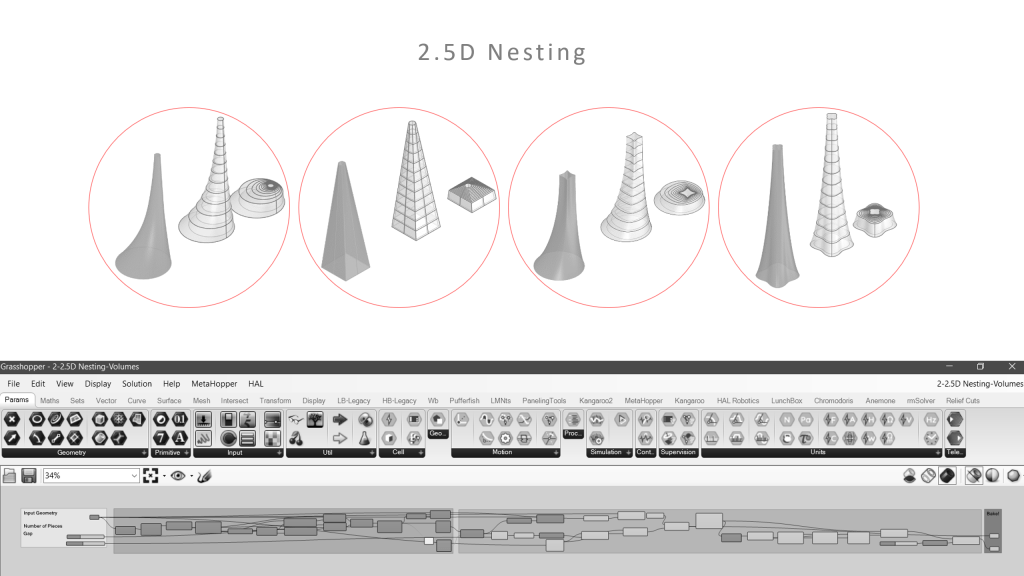
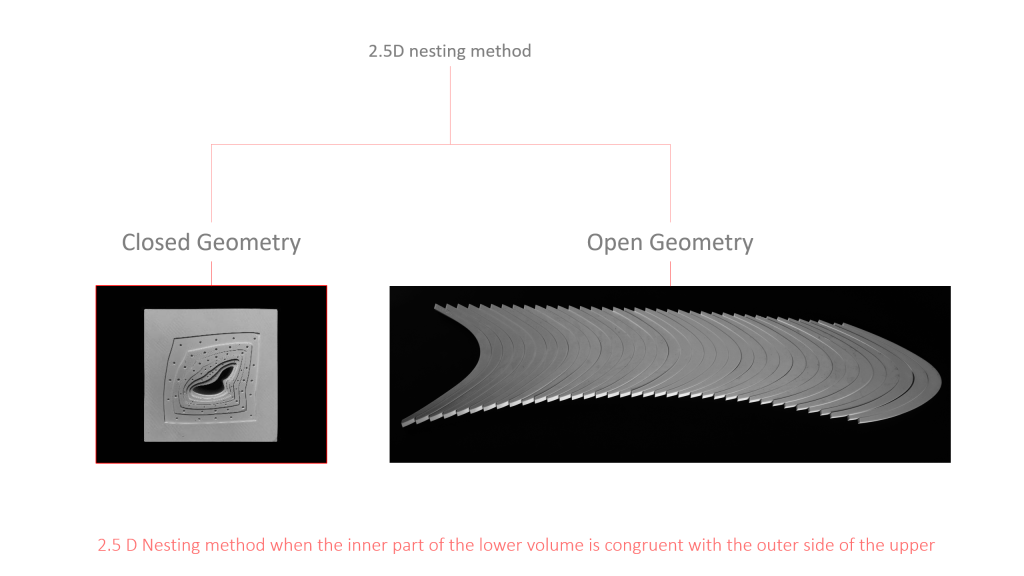
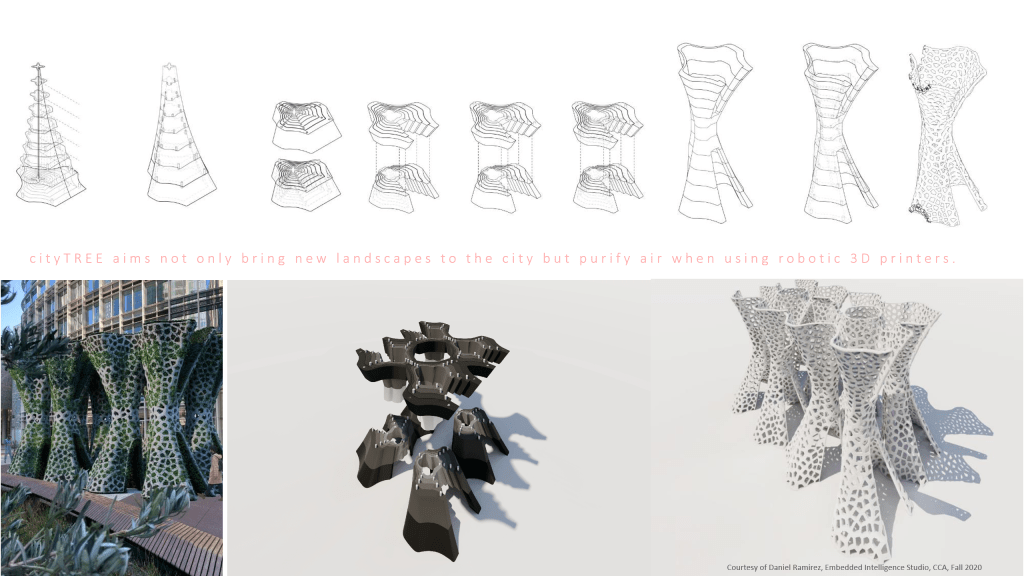
This research investigates a 2.5D nesting method that transforms freeform volumes into stackable components by organizing subdivided parts to nest consecutively without collision. The technique accommodates both open and closed geometries, each presenting distinct opportunities and constraints.
For closed geometries, the method generates a compact, centric stack of continuous ring-like components. These offer efficient storage and simplified assembly but require angled surfaces to maintain uniform thickness. Curvature transitions—where Gaussian curvature changes sign—necessitate splitting the object into separate stacks to avoid collision.
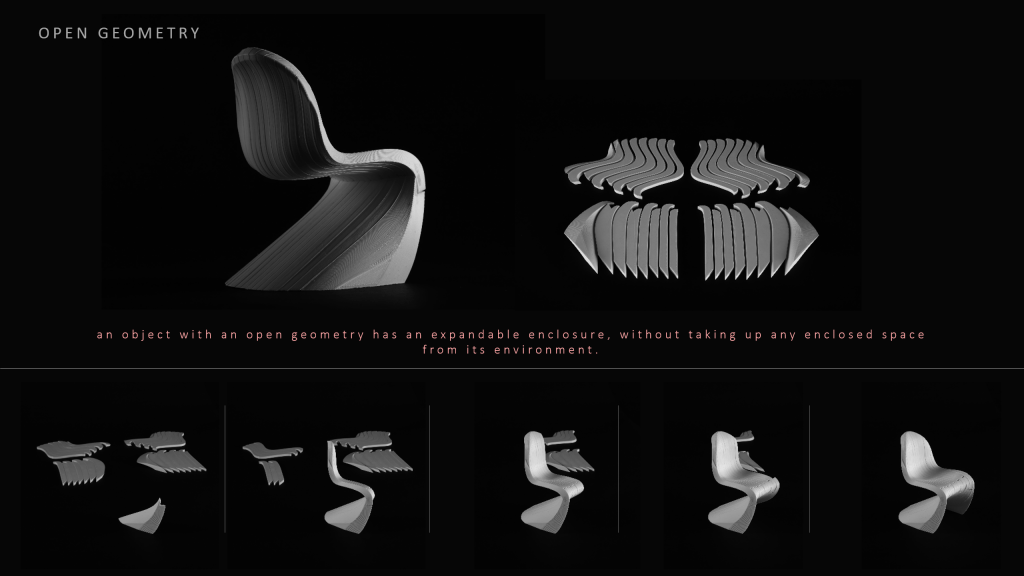
In contrast, open geometries produce non-centric stacks that allow consistent component thickness and greater freedom in form. This category does not require curvature-based separation, enabling a single, uninterrupted nesting sequence regardless of surface curvature.

 NEGAR KALANTAR