a2o | Responsive Mediator
2013-2014 | Virginia Tech | PARTeE: Interdisciplinary Design Laboratory
Collaborators: Grinham in collaboration with Partee
Link: Video
Project Description: To engage with the field of intelligent and adaptive physical-digital built environment, a deep understanding of the behavior of users and dynamic environments, including the interaction among people and their surroundings, is essential to address the aesthetic, social, psychological issues as integral parts of the design. As one area of interactive architecture, “Interactive Ornament” manifests a new aesthetic affect that exploits the symbiotic relationships between the exterior and interior spaces of a building to discover a new order between the tectonic, ornament and material.
In this project, by investigating the technical requirements of physical computing in relation to design, the goal was to explore the future of architecture that integrates computationally driven physical kinetic systems and components into buildings and spaces to meet the changing human needs. Here, we did not seek to answer what architecture is, but rather ask what can it do? The ever-expanding toolkit of off-the-shelf robotics, open source computing, and knowledge communities have lowered the threshold for designers to explore this question. The development of two advanced working prototype, named FLOWer and a2o, provided a construct in which questions can be asked: Can architecture actively and dynamically change physical environments in real time while becoming a social medium? Can architecture connect the virtual and the physical? Can architecture become an interface to construct what once thoughts were disparate ideas?
By using “off the shelf” electromechanical components such as servomotors and linear actuators, the prototypes were developed through the open source programming language, Processing, in conjunction with open source microprocessors, Arduino. Sensory data was read by the prototypes through the microprocessors to probe parametric and kinetic relationships in real time, allowing designers the ability to virtually test designs using onsite sensors with real time data.
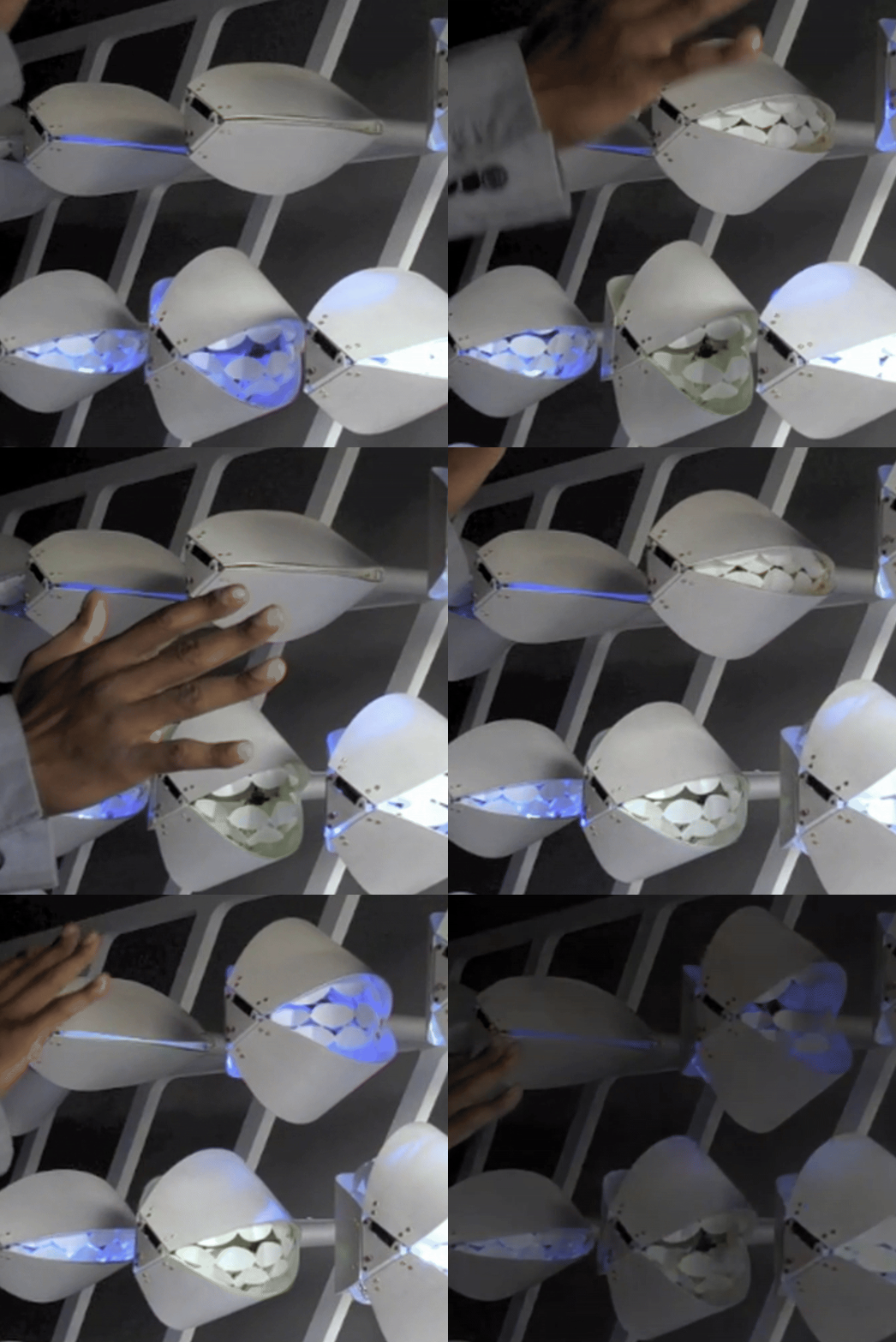
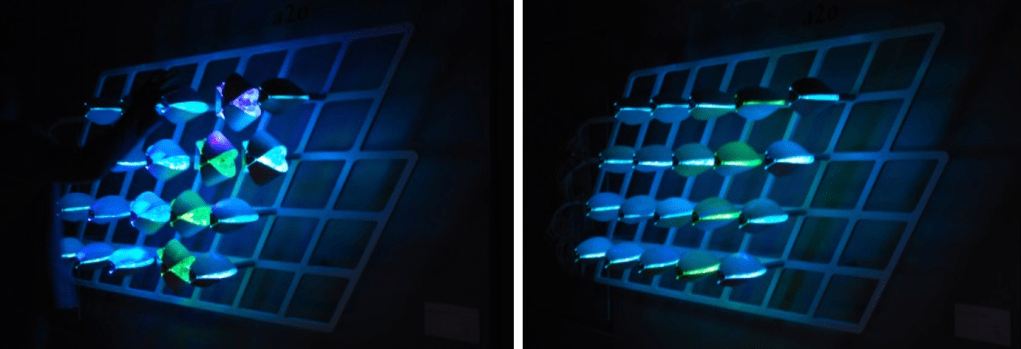
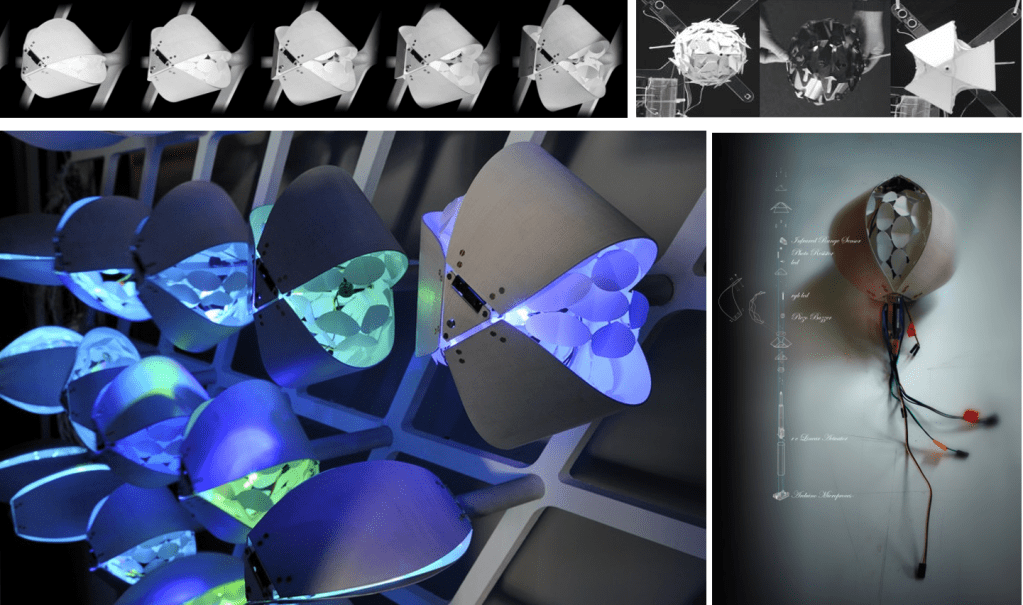
In a2o a field of extended a2o units was arrayed across a building’s southern curtain wall. In a2o, each unit contained dedicated sensors (infrared range finder and photocell) and dedicated actuators (linear actuator, RGB LED, and piezo buzzer). Sensory data collected by each individual unit was relayed to a master controller which controlled a pixel of five units. The adaption of cellular automaton logic allowed for the piece/part system to be expanded infinitely as each pixel within the system became a unit within the subsequent pixel. By arriving the building occupants, the facade took on a new aesthetic, becoming a living poche. As the users circulated through the space, their silhouettes were impressed upon the field as fenestrations moving through the facade. The individual units were extended out from their contracted state when their localized distance sensor perceived users in the space. The result was an isolated view for the users.


 NEGAR KALANTAR